Friday, December 25, 2009

Tectonic Plates: Shaping and Reshaping Gaia since ages


The structure of the earth's interior is layered, and broadly three layers can be identified- crust,mantle and the core.

Crust is the outer thin layer with a total thickness of around 100Km and forms 0.5% of the earth's volume.Mantle lies between 100 to 2900 Km below the earths surface and forms 16% of the earth's volume.Core lies between 2900 to 6400 Km below the earth's surface and accounts for 83% of the earth's volume.Our earth is undergoing deformations imperceptibly and inexorably. These deformations are caused by the movements generated by various factors:

1. The heat generated by the radioactive elements in earth's interior.

2. Movement of the crustal plates due to tectogenesis.

3. Forces generated by rotation of the earth.

4. Climatic factors

5. Isostacy.

The seafloor points to the movement of the earth's crust, in relation to each other takes place primarily due to three factors - polar wandering( It is the relative movement of the earth's crust and upper mantle with respect to the rotational poles of the earth), continental drift ( It refers to the movement of the continents relative to each other) and sea floor spreading( It describes the movement of the oceanic plates relative to one another).

PERMIAN , 225 million years ago
TRIASSIC , 200 million years ago

JURASSIC , 135 million years ago

CRETACEOUS , 65 million years ago

PRESENT DAY

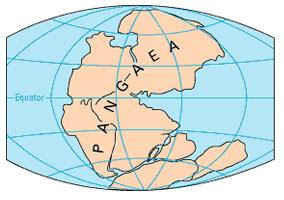
Continental Drift theory: Wegner,a climatologist wanted to investigate the relative distribution of land and sea and the climatic aberrations of the past.He postulated that originally(225 million years ago) all of the land masses of earth were locked together as a great supercontinent called PANGAEA which was covered by one big ocean called PANTHALASSA. A sea called TETHYS divided the PANGAEA into two huge landmasses _ LAURENTIA to the north and GONDWANALAND to the south of Tethys.The drift started around 200 million years ago and the continents began to break up and drift away from one another. The drift was in two directions - equatorwards due to interaction of forces of gravity and buoyancy, and westwards due to tidal currents because of the earth's motion and the drift is still continuing.From the analysis of the continental drift The following points can be observed.

1. South America and Africa seem to fit in with each other, especially the bulge of Brazil fits into the Gulf of Guinea.

2. Greenland seems to fit in well with Ellesmere and Baffin islands.

3. The east coast of India, Madgascar and Africa seem to have been joined.

4. North and South America on one side and Africa and Europe on the other fit along the mid-Atlantic ridge.

But, the main drawback of the wegner's theory is that he failed to explain why this drift began only in the Mesozoic era and not in the period prior to it.


Sea floor spreading: The authors of this theory recognised the existence of Pangaea , tethys and Panthalassa and tried to explain the apparent movement of sea floor at specific locations.According to this theory, the intense heat generated by radioactive substances in the mantle(100 to 2900 Km below the earth surface) seeks a path to escape, and gives rise to the formation of convection currents in the mantle. Wherever rising limbs of these currents meet, oceanic ridges are formed on the sea floor and wherever the falling limbs meet oceanic trenches are formed.At the ridges, the eruption results in upwelling of the magmatic material. This causes movement of the crust.After upwelling, the hot magma cools down, solidifies and moves apart to make way for the material of successive eruptions. This results in effective sea floor spreading. Thus discrete segments of earth's crust are formed by solidification of this erupted material at mid-oceanic ridges. Based on this, theory of plate tectonics was formulated.

Plate tectonics: According to this theory, the lithosphere(upper 100 Km of the earth's crust) is broken into a number of plates or sections, each of which is capable of independent movement over the asthenosphere.The movement of these crustal plates causes the formation of various landforms and is the principal cause of all earth movements.There are six major plates and many minor ones. The major plates are American, Eurasian, African, Indo-Australian, Pacific and the Antarctic. The minor plates include North American, South American, Nazca, Turkish, Aegean, Arabian, Caribbean, Phillipine, Juan de Fuca and the Iranian plate. The average thickness of these plates is around 100 Km and the entire thickness is involved in crustal spreading and are moving at a speed that has been estimated at 1 to 10 cm per year

Types of Plate Boundaries:

At the boundaries of the plates, various deformations occur as the plates interact.

There are 3 primary types of Tectonic Plate boundaries:Divergent boundaries; Convergent boundaries; and Transform boundaries.

At divergent boundaries new crust is created as two or more plates pull away from each other. Oceans are born and grow wider where plates diverge or pull apart.When a diverging boundary occurs on land a 'rift', or separation will arise and over time that mass of land will break apart into distinct land masses and the surrounding water will fill the space between them.For example, Surtsey island(south of Iceland) was born along mid-Atlantic ridge and even earthquakes also occur at the divergent boundaries.

Here crust is destroyed and recycled back into the interior of the Earth as one plate dives under another.The zone of collision may undergo crumpling and folding and folded mountains may emerge.When one of the plates is an oceanic plate, it gets embedded int he asthenosphere of the continental plate and as a result, trenches are formed at the zone of subduction. The subducted material gets heated up and is thrown out forming volcanic islands.Similarly, When two continents meet head-on, neither is subducted because the continental rocks are relatively light and, like two colliding icebergs, resist downward motion. Instead, the crust tends to buckle and be pushed upward or sideways.The collision of India into Asia 50 million years ago caused the Eurasian Plate to crumple up and override the Indian Plate. After the collision, the slow continuous convergence of the two plates over millions of years pushed up the Himalayas and the Tibetan Plateau to their present heights.

Transform-Fault Boundaries are where two plates are sliding horizontally past one another. These are also known as transform boundaries or more commonly as faults.

When two plates move sideways against each other (at a transform plate boundary), there is a tremendous amount of friction which makes the movement jerky. The plates slip, then stick as the friction and pressure build up to incredible levels. When the pressure is released suddenly, and the plates suddenly jerk apart, this is an earthquake.San Andreas fault along the western coast of USA is an example.

Thus, all landforms are influenced directly or indirectly by tectogenesis which provides energy for formation of landforms. Because of interplay of the factors, the plate margins are areas of intense volcanic and earthquake activity.

Significance of plate tectonics:

If the present trends continue, North and South Americas will separate. A piece of land will separate from western USA, and California will move northwards closer to San Fransisco. A piece of land will separate from the east coast of Africa. Australia will move closer to Asia.Two hundred million years from now a new Pangaea will be formed when all lands again converge. Then, inevitably, another break-up will ensue as our restless planet continues to reform and reshape itself.

Thursday, October 1, 2009

French Movie "Home"

Life started on Earth some 3.6 eons (1 eon = 1 billion years) ago. The first living creatures are the microbes, the foundation for the complex organisms to evolve. Plants and trees are formed which are the most creative standing structures with their growth always tending towards the sky. 6% of the Earth's land is tropical rain forests. There are countless species originated on the earth and each species has its unique place in maintaining the overall balance of Earth. Human beings initially depended on forests for their survival. Agriculture was one major invention that changed the human eating habits and laid foundations for civilizations. Agriculture has become the major source of human survival. Vast forest lands were cleared to start production of various food grains. Tillers of the soil used hands and manual labour to plough land and harvest crops till 20th century. With the advent of oil extraction the scene of agriculture changed completely. Machines, especially in America mechanized crop production leading to even surplus production of grains. Pesticides and fertilizers were invented and used extensively to ensure high yields. There are only 600,000 farmers in the US where as the farm land is 440 million acres. (750 acres per worker). The models created by America were soon followed by other western countries and the developing nations as well.

The oil revolution changed the face of Earth. Big cities with sky scrappers soon became the centers of human living. Nearly half of the world's population today lives in Big cities. Minerals and metals are mined from the earth to meet the needs of these big cities. Oil extraction, mining and transportation together lead to massive amounts of CO2 and other green houses gases to be released onto the atmosphere. The average temperature of earth in the last 15 years was the highest ever temperature since humans lived on this planet. As a results the ice caps on the Arctic are melting. The movie again showcased breath taking visuals of the arctic ice caps, how its thickness is reduced and how the melted fresh water merges with the oceans leading to raise in sea levels. The cities on the coast are the first ones at danger. The raise in sea levels will salinate the ground water on which is the primary water source for most cities.

The effects of global warming are already seen in countries like Bangladesh which is constantly hit with cyclones due to change in climate patterns. Nearly 200 million people are likely to be displaced because of global warming and its effects. The industrialization and globalization of economies not only changed the climate but also created huge disparity between the rich and the poor. The irony is that poverty is more in the countries that are rich with resources like India, Africa and Brazil. There are deserts on earth where people survived on fossil waters for drinking water. Las Vegas is also built on a desert where an individual consumes 1000 litres a day. The colorado river which supplies water to all big cities in America is one of those rivers that never reaches sea.

The movie ended with a statement that is it too late to be pessimist and highlighted some positive changes and revolutions that started. There are still fresh water resources on earth untouched by pollution. There are still 50% of rain forests remaining. There are still ground water reserves. Even now there are 60% of farmers in the world tilling the soil with hands. True, its too late to be a pessimist. Together we created the climate change. Together we can undo it.

Man on Earth is 200,000 years old on the Earth which is 4 billion years old. As James Lovelock said in his Gaia theory, "In Gaia we are just another species, neither the owners nor the stewards of this planet. Our furture depends much more upon a right relationship with Gaia than upon the never ending drama of human interests".

Panel discussion: There was a brief and succinct panel discussion on audience questions. Some of the important points discussed

1. What can we do as individuals ? The panel suggested that a deeper change in the fundamental value systems upon which the society is based is required. Each individual can adapt a sustainable life style. One example is that our buying choices should be made based on absolute need. We should know where the products that we are buying are coming from. If they are coming from more than 500 miles radius, try to avoid them.

2. The issue of global warming is a political issue. The policy makers should be forced to put in right policies in place. For e.g farmers in dry lands like Rayalaseema are giving away Jowar and other traditional crops suitable for their region because of government subsidies for rice.

3. How much as individuals are we ready to give up personal comforts for e.g say Air conditioning. It is possible to build houses that can be much cooler without requiring AC ? Do we question the solutions given to us or are we conditioned to accept everything given to us ?

4. Youth and students need to be more responsible and raise their voice against the issues that will concern their future. For e.g privatization of education. No student organization is protesting against privatization of education. 10 years back the student movements on these issues was much stronger.

5. The movie is available on youtube. Viewers are requested to promote the movie widely.

Sunday, September 20, 2009

The land of Hand Weavers.


Pochampally is a small town in Nalgonda district 45Km from Hyderabad city.In Pochampally there are well built schools,shops,hospitals even cinema halls. Pochampally is mostly famous for hand weavers.There are close to 20 handloom weaving clusters in Andhra Pradesh. Nalgonda district has the highest number of villages which have formed into a cluster. There are 5 villages in this cluster which are Bongiri, Bhoodan Pochampally, Puttapaka, Koyalgudem,Chanduru. Pochampally is popularly called as Bhoodan Pochampally because this is the place where the Bhoodan movement was started by Acharya Vinoba Bhave. There is a rural tourism complex where there was an exhibit of the photos of the process involved in preparing till the final costume is obtained and also, the weavers machine used to weave the cloth.

The raw material that is used is mulberry silk.
The cloth is boiled in a wide tin with some chemicals also added in it.There are two colors of thread: ordinary and cream colored. For getting cream colored thread little cream colour is added in the tin.

Then the cloth is dried.

The threads are rotated on a charaka so that it will form like a spindle. This process is called yarn winding.

The warp preparation is done where all the threads are tied between two sticks and this is useful while weaving the final cloth. This is for creating the vertical threads present in the cloth.

Then another set of threads are tied on a weaving machine where on one side it has one long stick and on other side it has a lot number of sticks which are smaller in size in a one to many mapping. There is a rotating wheel on top of the weaving machine which will be rotating around the weaving machine from long stick to one of the smaller stick by pulling the thread fom the spindle.This way the thread is tied on all the small sticks. Multiple sets of threads are created in this process called weft preparation.


After that on the weft then the designs are marked.

Then the particular threads which are of the same colurs or same pattern are tied. This is called design tyeing.

The colurs which are required to be dyed are then boiled.

After this the rubbers are tied to the set of threads where only one particular colour has to be applied. Then that particular is applied and the threads will be coloured only on the places where rubbers are not tied.

Then the rubbers can be removed. In this way all the required colours and applied by tying rubbers to it appropriately.After the colours are applied the threads are dried.

Then the threads are winded on a bobbin which are useful as vertical threads during the final weaving of the cloth.So, both the horizontal and vertical threads are coloured and are ready for weaving the cloth.

Then the cloth is weaved on a weaving machine where the vertical threads are tied up. Then the horizontal threads are kept in a needle and this is moved left and right. Each time the thread moves left the thread has to be aligned and then the horizontal threads have to be moved so that an interlock happens between both of them. So the horizontal thread will be placed in between two vertical threads.Here hand movement, pedal movement and alignment all have to be done synchronously else the needle will be coming out. After weaving in this process for a lot number of times finally the cloth is prepared.

In Boodhan Pochampally silk sarees are weaved whereas in Koyalgudem which is at a distance of 5 Km from Boodhan Pochampally,cotton clothes are weaved.After such a lot of hard work also the weavers are getting very less wages.If a sample estimate is observed the following are the details:

Product on Weave : Silk Saree
Nature of Yarn : Mulberry Silk
Yarn Cost : Rs. 7500.00
Dyes and Chemicals : Rs. 500.00
Process Cost : Rs. 1100.00
Total Cost of sarees : Rs. 9100.00
Duration of weaving for
7 sarees : 45 days
Wages earned : Rs. 3375.00
Wages per day : Rs. 75.00

One historical reason why the town Pochampally was famous for is the Bhoodan movement. Acharya Vinoba Bhave, a great disciple of Mahatma Gandhi and first satyagrahi started his movement with the first Bhoodan gift from vedere RamaChandra Reddy in this town Pochampally.After India got independence, Vinobha started on his extraordinary and unprecedented in the history, the Bhoodan Movement. Over a period of twenty years, he walked through the length and breadth of India persuading Land owners and landlords to give a total of four million acres of land to the poor and downtrodden. This movement brought Vinobha to the international scene.

In coming to Hyderabad, Vinobha and other Gandhians were confronting a challenge and testing their faith in non-violence. They toured the communist infested areas of Telangana to spread the message of peace. With his efforts he made a landlord sanction 100 acres to Harijans in a village called Pochampalli. This incident was the very genesis of the Bhoodan movement which later on developed into a village gift or Gramdan movement. This movement passed through several stages in regard to both momentum and allied programmes. This reminded the Gandhi’s mass movements. The enthusiasm for the movement lasted till 1957 and thereafter it began to wane.

Sunday, September 6, 2009

Timbaktu - In the lap of mother Nature

A view of Timbaktu

Timbaktu, an NGO located at a distance of 50Km from Anantpur and later this place itself became popular with the name as Timbaktu. This organisation mainly works on activities such as providing basic education to children from surrounding villages, mobilizing farmers to take up organic farming, creating women groups to name a few. All the activities reflect the deep holistic vision of the group and the fundamental belief that people have the strength and ability to address their problems and live in harmony collectively without entirely depending on an external agency like government for creating social order. More often than not the social order proclaimed to be created by such external agencies (like government)lack holistic vision and have meagre people participation. In Timbaktu Badi (Badi means school), the education is provided to children from standard 1 to standard 10 and the children after completing their tenth standard were sent to colleges in Anantapur district depending on the kind of studies they want to go for. Here all the students who are below tenth standard have both boarding and lodging facilities. The students are being taught in the classrooms where they have opportunity of learning the education while enjoying the nature as if it is in case of gurukulas in the olden days. The classrooms are constructed in such a way that they are at different places and the students are being taught at different locations everytime depending on the nature and the type of learning activity or topic. One such type of classroom is like an amphitheatre where they have a blackboard on one of the wall and a stage like environment. The children are being taught in creative methods and the teachers are also creating methods so that the children can learn practically even the minute detail. There are almost 70 children from 350 villages who are in Timbaktu Badi. There are 2 kitchens and the students, teachers and the staff members all of them have their food in any of the kitchen. Nearly 100 persons can have their food in the kitchen at a single time. The food is cooked mostly using firewood and the mud kiln is made in such a way that smoke goes out of the exhaust pipe. Few Timbaktu members also stay in the houses provided there. All the houses have roof made from locally available wood from inside and on the outside the roof is covered with a special type of grass found in Timbaktu lands, which makes the house very cool. You can just feel as if u are living in a house with an AC, so it is that much cool and fresh air circulating inside the house. Anantapur area even though very dry, has very good wind flow and these houses are built to take advantage of the local geographic conditions. The facilities do not have any electricity coming from the electricity board, instead they use electricity generated from the solar energy which is useful for the minimum lighting during nights, running communication equipment, laptops and also one small water pump. Most of the area is covered with a lot of trees so there is a fresh breeze surrounding everywhere in the place. They have a organically grown kitchen garden where few fruits and vegetables are grown. Since the land in Timbaktu premises doesn't have enough ground water it cannot support any farming. The drip irrigation system is used for watering the plants. Brinjal, beans, mirchi, bottle guard, bitter gourd, tomato , custard apple, papaya, gongura are the vegetables and fruits grown. There are few hens and a peacock which came there on its own and living there. He is called Sundarayya (man of beauty). One of the most amazing thing is Sundarayya, dancing every morning and evening exactly at 5:00 clock. Even we people also do not know the time so exactly by seeing the climate outside. It widens its feathers and dances so beautifully. Sundarayya seems to have developed friendship with the hens and he entertains and plays with the hens. He expresses his joy to the hens by way of opening his feathers and dancing everyday. He moves along with the hens in a desperate attempt to impress the hens. There are also large number of snakes around the area as the area has wilderness. Dinesh, another member of Timbaktu has a natural love and instinct for snakes. He can sense their presence, catch them, live with them - Amazing skill that he got very naturally. If one goes on trekking the nearby hills surrounding Timbaktu there are even bears and foxes. Subba, who is living in Timbaktu for past 14 years says, it is actually much easier and peaceful to live in the vicinity of wild animals than it is thought. The snakes for example bite people in villages as they cannot escape. The villages do not have wilderness preserved and hence the snakes cannot escape easily. Whereas in Timbaktu the snakes are occasionally seen but they never interfere with human life. Snakes need very less food and prefer sleeping most of the time. They are very peaceful beings, infact Subba refers to them as meditators. Some of us who visited Timbaktu that day wanted to invest in organic farming. We thought it is one easy way to take part in Timbaktu's activites. Another one expressed interest in forming an informal network in hyderabad to collectively buy Timbaktu products. We want to visit Timbaktu again for atleast a week and learn from the children in Timbaktu Badi and ofcourse rest in the lap of mother Nature. So wonderful and peaceful is Timbaktu !

Thursday, August 20, 2009

Law of the Stars

.....Ah, not to be cut off,
not through the slightest partition
shut out from the law of the stars.
The inner -- what is it?
if not the intensified sky,
hurled through with birds and deep
with the winds of homecoming.

~ Rainer Maria Rilke

Friday, August 7, 2009

Gratitude...

This being human is a guest house.
Every morning a new arrival.

A joy, a depression, a meanness,
some momentary awareness comes
as an unexpected visitor.

Welcome and entertain them all!
Even if they are a crowd of sorrows,
who violently sweep your house
empty of its furniture,
still, treat each guest honorably.
He may be clearing you out
for some new delight.

The dark thought, the shame, the malice.
meet them at the door laughing and invite them in.

Be grateful for whatever comes.
because each has been sent
as a guide from beyond.

~ Jelaluddin Rumi (translation by Coleman Barks)

Tuesday, August 4, 2009

Fire & Rose...

........All shall be well and

All manner of thing shall be well

When the tongues of flame are in-folded

Into the crowned knot of fire

And the fire and the rose are one.

~ T S ELiot